Choosing the right packaging box is more than a logistics decision; it directly affects product protection, shipping costs, branding, and customer experience.
When it comes to packaging, choosing the right box for your product is more important than you might think. Not only does it protect your items during shipping, but it also plays a big role in how your customers perceive your brand. Two common types of boxes you might come across are mailer boxes and carton boxes. But what’s the difference between the two, and how do you know which one is the best fit for your product?
In this article, we’ll dive into the details of mailer boxes and carton boxes, compare their advantages and disadvantages, and help you figure out which one is the best option for your business or personal needs.
What Are Mailer Boxes?
Mailer boxes are typically made from cardboard and are designed to hold a product during shipping. They are often used for smaller, lightweight items that don’t require extra layers of protection. Mailer boxes have a simple design, usually featuring a tuck-in or fold-over closure, which makes them easy to pack and seal.
These boxes are often used by e-commerce businesses and subscription box services because they are lightweight and cost-effective. You can find mailer boxes in various sizes and shapes to suit a variety of products. For example, a company selling custom T-shirts might use a mailer box to ship their items, while a jewelry business might also use one for small but delicate items.
Mailer boxes are self-locking corrugated boxes designed to ship products directly to customers without the need for extra packaging.
Key Features of Mailer Boxes:
- Compact and lightweight: Mailer boxes are generally smaller and lighter than carton boxes, which makes them ideal for shipping products that don’t require a lot of space.
- Simple design: They usually feature a folding closure that requires no extra tape or adhesives, making them fast and easy to assemble.
- Cost-effective: Because mailer boxes are smaller and lighter, they are often less expensive to produce and ship compared to larger carton boxes.
- Branding potential: Mailer boxes can be customized with colorful prints, logos, or messaging, making them an excellent choice for businesses that want to create a memorable unboxing experience for customers.
What Are Carton Boxes?
Carton boxes, on the other hand, are usually larger and sturdier than mailer boxes. These are the boxes we typically associate with moving, packing, or shipping bulkier items. Carton boxes are designed to handle heavier loads and provide more protection for fragile or valuable products.
Unlike mailer boxes, carton boxes come in a variety of sizes, from small ones that fit books or electronics to large ones for bulky or oddly shaped items like furniture or appliances. These boxes often require tape or other sealing methods to secure them properly.
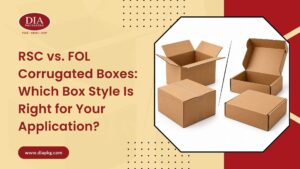
Carton boxes, often referred to as regular slotted containers (RSCs), are traditional shipping boxes that require tape to seal.
Key Features of Carton Boxes:
- Stronger and more durable: Carton boxes are often made with thicker cardboard or multiple layers of material, making them suitable for heavier or more delicate items.
- Variety of sizes: There is a wide range of sizes available, so you can choose the right box for anything from small electronics to large furniture.
- Added protection: Because of their sturdier construction, carton boxes offer more protection against damage during transit, especially for fragile or high-value items.
- More complex assembly: Carton boxes often require more time to assemble and secure, especially when you need to tape or glue them shut.
Mailer Boxes vs. Carton Boxes: A Side-by-Side Comparison
When trying to decide between mailer boxes and carton boxes, it’s important to consider several factors, including the size and weight of your products, the level of protection they need, and your shipping budget. Below is a comparison of both options to help you make the right decision.
1. Size and Product Fit
Mailer Boxes: These boxes are designed to fit snugly around smaller, lightweight products. If you’re shipping small items like clothes, books, cosmetics, or accessories, a mailer box is often the best choice. They’re easy to store and handle because of their compact size.
Carton Boxes: Carton boxes come in a much broader range of sizes, which means you can pack larger or bulkier items without worrying about fitting them into a box that’s too small. If you’re shipping bigger products or items that don’t fit well into a mailer box, carton boxes will give you the space and flexibility you need.
2. Protection and Durability
Mailer Boxes: Since mailer boxes are usually thinner and less sturdy, they are best for shipping lightweight and durable items. If your product is fragile or valuable, a mailer box might not offer enough protection during shipping.
Carton Boxes: Carton boxes are often thicker and stronger than mailer boxes, making them the better choice for heavier or more fragile items. The added strength can provide better protection against bumps and falls during transit. For example, shipping electronics or glass items in a carton box is a safer option than a mailer box.
3. Cost Considerations
Mailer Boxes: Mailer boxes are typically more cost-effective for businesses that are shipping small and lightweight products. They’re cheaper to produce and ship because they are smaller and lighter, which can help you save on shipping costs.
Carton Boxes: Carton boxes are generally more expensive because they are larger and more durable. They also tend to cost more to ship due to their heavier weight and the space they take up. However, if your product requires more protection, the extra cost could be worth it.
4. Branding and Customer Experience
Mailer Boxes: One of the main benefits of mailer boxes is the opportunity they provide for branding. Because they are smaller, they allow for more creative designs and a more personalized unboxing experience. Many businesses use mailer boxes to create a unique and memorable experience for their customers. Whether it’s through custom colors, logos, or messages, mailer boxes are a great way to reinforce your brand image.
Carton Boxes: Carton boxes are generally more functional than flashy. While they can be branded, their size and design are less likely to provide the same kind of memorable unboxing experience as mailer boxes. However, if you’re shipping larger products or goods that require more protection, the focus is likely on safety rather than presentation.
5. Assembly and Ease of Use
Mailer Boxes: Mailer boxes are easy to assemble, often requiring just a simple fold-over or tuck-in closure. This makes them ideal for businesses that need to quickly and efficiently pack and ship their products.
Carton Boxes: Carton boxes usually take more time to assemble because they may require tape or glue to secure them properly. This can add extra time and effort to the packaging process. However, if you need a box that can hold a larger or more delicate item, the extra time may be worth it.
Which Box is Right for Your Product?
To help you decide whether a mailer box or a carton box is the right choice, let’s break down some common scenarios:
- Clothing, Jewelry, Cosmetics (If you are shipping small, lightweight items)
Mailer boxes are a great option because they are easy to use, cost-effective, and provide enough protection for these types of products. - Electronics, Glass items (If your products are fragile or require extra protection)
Carton boxes are the better choice. Their added strength and durability make them ideal for shipping delicate or valuable items. - Furniture, Home Appliances (If you are shipping bulky or oddly shaped items)
Carton boxes provide more flexibility in size and will give you the space you need to safely pack and protect larger products. - E-commerce or Subscription boxes (If you want to create a memorable unboxing experience)
Mailer boxes are the way to go. Their compact design allows you to add custom branding, colors, and messaging to make the unboxing experience special for your customers.
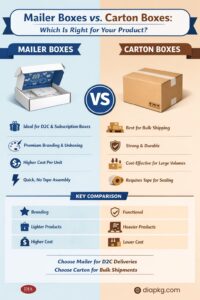
Mailer Boxes vs. Carton Boxes: Quick Comparison Table
| Feature | Mailer Boxes | Carton Boxes |
|---|---|---|
| Best Use | D2C shipping | Bulk & logistics |
| Branding | Excellent | Basic |
| Cost | Higher | Lower |
| Packing Speed | Fast | Moderate |
| Protection | Moderate | High |
| Shipping Type | Parcel | Palletized |
Final Thoughts
Both mailer boxes and carton boxes play essential roles in modern packaging. The right choice depends on your product type, shipping method, budget, and branding goals. With aligning your packaging choice with your business needs, you can improve efficiency, reduce costs, and deliver a better customer experience.