Choosing the right corrugated box is important when you need to pack, store, or ship products safely. A box that is too weak can bend, crush, or break during handling. A box that is much stronger than needed can cost more and may use more material than necessary.
Two common ways to measure the strength of a corrugated box are ECT, or Edge Crush Test, and Burst Strength. Both tests tell us something useful about a box, but they measure different things.
So, how do you know which one to choose?
Let us look at ECT and Burst Strength in simple terms and understand when each one may be the better choice.
What Is ECT?
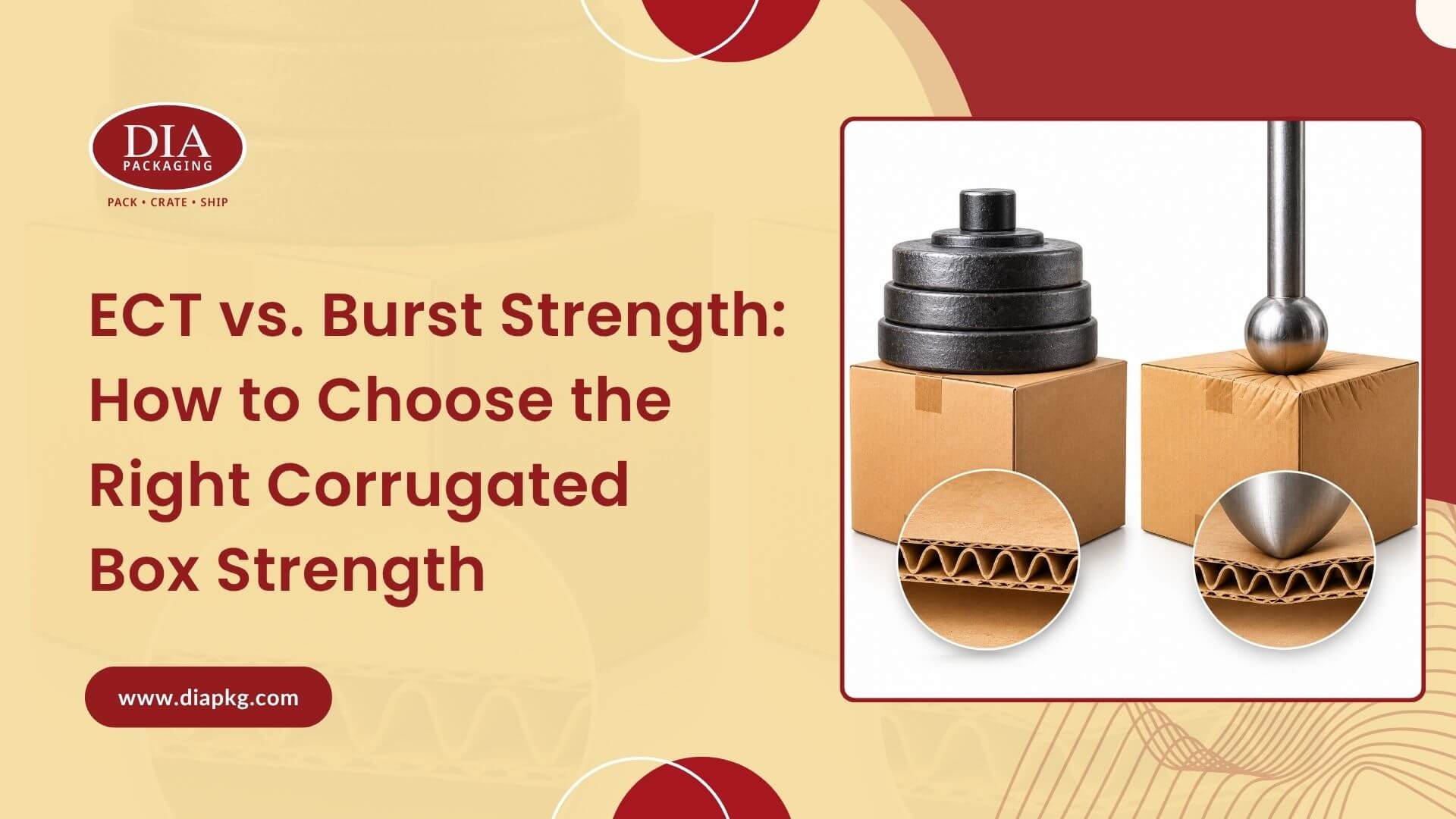
ECT stands for Edge Crush Test. It measures how well the edges of corrugated cardboard can handle pressure.
Think about a stack of boxes in a warehouse. The boxes at the bottom have to support the weight of the boxes above them. The walls of the box need to stay strong so they do not bend or collapse.
ECT helps show how well a box can handle this kind of pressure.
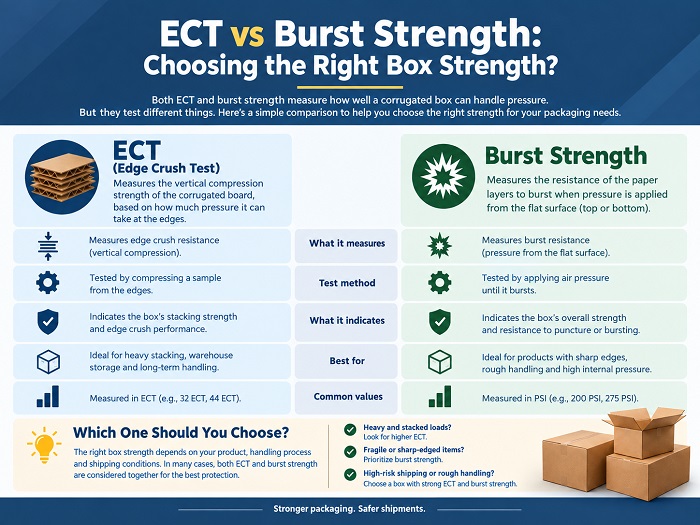
The result is usually given as a number, such as 32 ECT or 44 ECT. A higher ECT number generally means the box can handle more pressure from the edges.
ECT is especially useful when boxes will be:
- Stacked on top of each other
- Stored in a warehouse
- Transported in large loads
- Placed under pressure from other boxes
- Used for products that need protection during storage
For many modern shipping boxes, ECT is a common way to describe box strength.
What Is Burst Strength?
Burst Strength measures how much force it takes to break through the corrugated cardboard.
Imagine pushing your finger against a piece of cardboard. If the cardboard is weak, it may tear or break after enough pressure. Burst Strength looks at how much pressure the material can take before it bursts.
A box with good Burst Strength can be useful when the outside of the box may face rough handling, rubbing, or sharp pressure.
Manufacturers often show Burst Strength as a number of pounds per square inch, or PSI.
For example, a box may have a Burst Strength rating of 200 PSI. This means the cardboard can resist a certain amount of pressure before it breaks.
Burst Strength can be useful for boxes that need to handle:
- Rough handling
- Sharp or heavy products
- Pushing or rubbing from outside
- Products with hard edges
Conditions where the cardboard may be more likely to tear
ECT vs Burst Strength: What Is the Difference?
The main difference is what each test measures.
ECT looks at the box’s ability to resist crushing from the edges.
Burst Strength looks at how much pressure the cardboard can take before it breaks or tears.
A simple way to remember this is:
ECT = How well the box resists crushing
Burst Strength = How well the cardboard resists breaking
Neither test is automatically better than the other. The right choice depends on how you plan to use the box.
When Should You Choose ECT?
ECT may be a good choice if your boxes will be stacked during storage or shipping.
For example, imagine a company shipping 20 boxes of clothing to a store. These boxes may be placed on top of each other inside a truck or warehouse. The boxes at the bottom will carry the weight of the boxes above them.
In this case, the box needs good resistance to crushing. ECT can help you choose a box that is suitable for this type of use.
ECT boxes are also common for everyday shipping because they can provide good strength without always needing very thick cardboard.
If stacking is an important part of your shipping process, ECT is worth considering.
When Should You Choose Burst Strength?
Burst Strength may be more useful when the box needs to resist punctures, tears, or rough handling.
For example, suppose you are packing a product with hard corners or rough surfaces. During shipping, those edges may press against the inside of the box. A box with good resistance to breaking can help protect the package.
Burst Strength can also matter when the box may be handled roughly or exposed to conditions that can weaken the cardboard.
However, Burst Strength alone does not tell you how well a box will perform when stacked. That is why it is important to consider how the box will actually be used.
Which One Is Stronger?
It is not correct to say that ECT is always stronger than Burst Strength, or that Burst Strength is always better.
They measure different types of strength.
For example, a box can have good resistance to crushing but may not be the best choice for a product with sharp edges. Another box may have strong resistance to breaking but may not be the best choice for heavy stacking.
The best box depends on the job it needs to do.
Think About the Product Inside
Before choosing a box, look at the product you are packing.
- Is it light or heavy?
- Does it have sharp edges?
- Is it fragile?
- Can it move around inside the box?
- Will several boxes be stacked together?
The answers to these questions can help you decide what type of box strength you need.
A light product that will not be stacked heavily may not need a very strong box. A heavy product that will be stored under several other boxes may need stronger protection.
Think About Shipping and Storage
The journey your box takes also matters.
A box that only moves a short distance by hand may have different needs from one that travels across the country.
Think about what happens to the box after it leaves your hands. It may be loaded onto a truck, moved through a warehouse, stacked with other packages, and handled several times before reaching the customer.
If stacking is a major concern, ECT can be an important measurement.
If rough handling and resistance to tearing are bigger concerns, Burst Strength may deserve more attention.
Do Not Choose Based on the Number Alone
It is easy to look at an ECT or Burst Strength number and assume that a higher number always means a better box.
That is not always true.
A stronger box can cost more. It may also be unnecessary if your product is light and the box will not face difficult conditions.
The goal is to choose a box that gives your product the protection it needs without paying for strength you do not need.
You should also consider the box size, type of cardboard, packing method, and the weight the box will carry.
ECT or Burst Strength: Which Should You Pick?
There is no single answer for every product.
Choose ECT when resistance to crushing and stacking is a major concern.
Choose Burst Strength when resistance to tearing, punctures, and rough handling is more important.
In some cases, you may need to consider both. A packaging supplier can help you choose the right box based on your product, weight, shipping method, and storage conditions.
Final Thoughts
ECT and Burst Strength are two different ways to understand the strength of a corrugated box.
ECT shows how well a box resists crushing, especially when you stack boxes. Burst Strength shows how well cardboard resists breaking when pressure is applied.
The right choice depends on what your box will face during storage, shipping, and handling.
Instead of simply choosing the box with the highest strength rating, think about your actual needs. Consider your product’s weight and shape, how people will handle the box, and whether they will stack the boxes.
When you match the box strength to the job, you can protect your products and avoid spending more than necessary.